Understanding the Enamel Concern
Enamel is the outermost layer of your teeth, providing a protective barrier against temperature, pressure, and bacteria. According to the American Dental Association (ADA), enamel is the hardest substance in the body; unfortunately, it does not regenerate.
Since it cannot regenerate, there’s concern about “Does teeth whitening damage enamel?” Many people easily understand this concern; however, clinical studies show that approved whitening products do not erode tooth enamel when used as directed.
Before recommending any whitening, your dentist will examine the condition of your enamel. This is a necessary step because sensitivity or damage to your teeth is usually caused by previous conditions, not by whitening.
How Whitening Actually Works
The process for whitening does not involve grinding or scraping the outer layer of your teeth to remove stains; instead, safe bleaching products are used (hydrogen peroxide or carbamide peroxide). These ingredients break down the stain molecules within your teeth, leaving the enamel intact.
In many cases, patients asking about local whitening options want supervised treatment. Professional guidance ensures the correct strength, duration, and method are used. That is why many people choose professional teeth whitening in Stony Plain, AB, over guessing with random products.
What the process really does:
- Opens microscopic pores temporarily
- Lifts stain particles
- Allows oxygen molecules to dissolve discoloration
- After treatment, enamel naturally remineralizes with saliva and fluoride.
Common Teeth Whitening Myths Explained
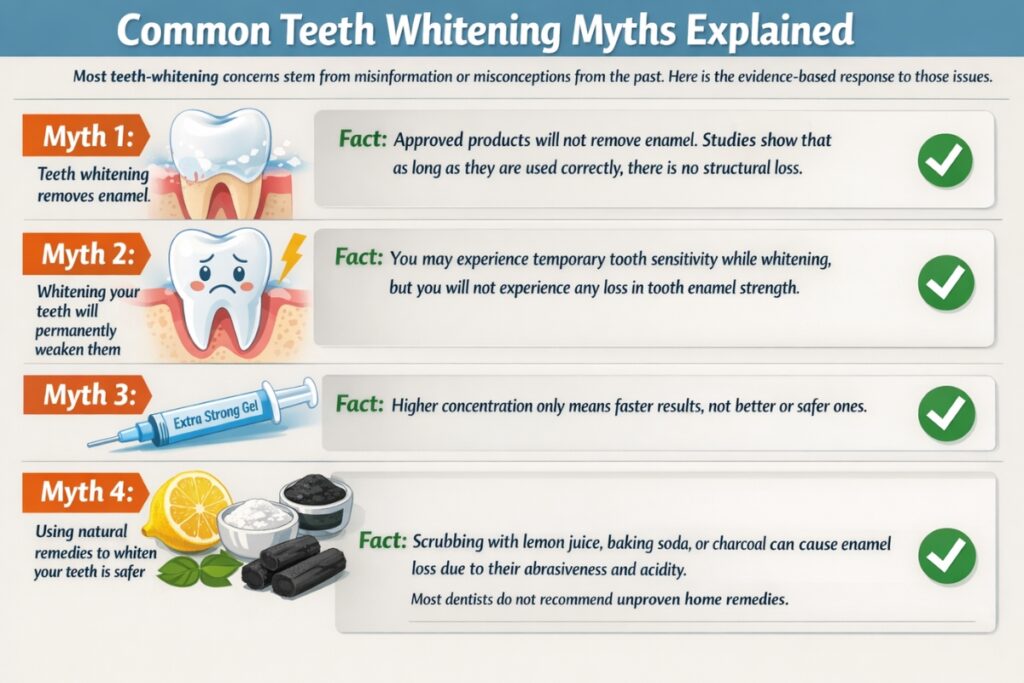
Most teeth-whitening concerns stem from misinformation or misconceptions from the past. Here is the evidence-based response to those issues.
Myth 1: Teeth whitening removes enamel
Fact: Approved products will not remove enamel. Studies show that as long as they are used correctly, there is no structural loss.
Myth 2: Whitening your teeth will permanently weaken them
Fact: You may experience temporary tooth sensitivity while whitening, but you will not experience any loss in tooth enamel strength.
Myth: Stronger gel means better results
Fact: Higher concentration only means faster results, not better or safer ones.
Myth 4: Using natural remedies to whiten your teeth is safer
Fact: Scrubbing with lemon juice, baking soda, or charcoal can cause enamel loss due to their abrasiveness and acidity; most dentists do not recommend using any home remedies for whitening that have not been proven safe.
Why Do People Sometimes Have Tooth Sensitivity After Whitening Their Teeth?
Tooth sensitivity after whitening does not mean you have harmed your teeth; it is usually the result of peroxide temporarily opening tubules in the dentin, which allows temperature signals to reach the nerves more easily.
Tooth sensitivity is typically mild and short-lived, and usually resolves within 24-48 hours after the bleaching treatment.
Dentists can reduce your risk for tooth sensitivity by:
- Examining for cracks or decay before treatment
- Using desensitization gels
- Adjusting the amount of time exposed to the bleaching gel
- Providing you with fluoride after your treatment
If your tooth remains sensitive, a visit to your dentist for evaluation may help determine the cause.
What Influences the Safety of Whitening Treatments?
The method of use will have a greater impact on your safety than the product name. Things to consider when determining whitening safety:
- Your overall dental health before the whitening treatment
- The correct strength of whitening gel to use
- The correct amount of time to leave the gel on the teeth
- You should protect your gums during the whitening process
- Have a thorough examination by your dentist before starting your whitening treatment.
Those with untreated dental decay, gum disease, or weakened teeth need to address these concerns before whitening. Whitening is only effective on healthy teeth.
Who Should Avoid Whitening Temporarily
The following patients would benefit from delaying their treatment until their cavity, infection, or damage is resolved:
- Patients with active cavitities
- Patients with inflamed gums
- Patients with worn enamel
- Patients whose tooth roots are exposed
- Patients who have restorations that need to be replaced
These patients will not have permanent restrictions from whitening; rather, they’ll have better protection for their teeth, which will promote better finishing results by treating the underlying problems first.
Tips to Protect Your Enamel from Whitening
By keeping your enamel healthy, you and your dentist will have a better chance of maintaining your whitening results. Below are some easy habits to continue after whitening:
- Brush your teeth at least twice daily for excellent hygiene using fluoride toothpaste
- Floss your teeth at least once a day
- Limit dark beverages as much as possible
- Rinse out your mouth after drinking coffee or tea
- Don’t smoke
Research shows that fluoride is important for maintaining enamel health by strengthening it and reducing sensitivity. Therefore, fluoride is an important part of your post-whitening maintenance program.
Signs You Should Make an Appointment with a Dentist Before Whitening
Before considering whitening, it is best to schedule a dental exam if you are experiencing the following:
- Tooth pain
- Dark spots on your teeth
- Bleeding gums
- Sensitivity to cold air
These signs may indicate a dental issue that needs treatment before proceeding with whitening. Therefore, it is only safe to whiten your teeth if your teeth are healthy.
The Truth About Enamel and Whitening
How many times have you been told or have heard that teeth whitening would ruin your enamel? If you knew better, you wouldn’t have believed that. There is scientific evidence to support that whitening through a dental professional means you are going to decrease your risk of damage to your enamel.
Patients must recognize the difference between what happens to enamel under scientific evidence of professional use and improper use, overuse, or dangerous DIY methods. Recognizing this difference will give you more confidence to make an appropriate decision about whitening, based on subjective factors rather than objective truth.
A Final Word Before You Decide
Whitening is safe for most people when done correctly. The key is proper evaluation, the right method, and realistic expectations. If you want brighter teeth, guidance matters more than product strength.
Choosing informed care protects both your smile and your enamel.
Schedule a Consultation for Personalized Guidance
If you want clear answers about whitening safety and options tailored to your teeth, schedule a visit with Lobay Dental Group. A professional evaluation helps you choose a method that brightens your smile while protecting your enamel.
Common Questions People Ask
1. Does whitening permanently thin enamel?
No. Research shows approved whitening agents do not reduce enamel thickness. Temporary sensitivity may occur, but the enamel structure remains intact.
2. How long do whitening results usually last?
Results vary based on diet and habits. Many patients maintain brightness for months to years with good oral hygiene and occasional touch-ups.
3. Can whitening fix deep stains?
Some intrinsic stains respond less to whitening. In those cases, dentists may recommend alternative cosmetic options to improve appearance safely.
4. Is sensitivity a sign that something went wrong?
Not necessarily. Mild sensitivity is common and temporary. Persistent discomfort should be evaluated to rule out hidden dental problems.